For live music rooms
You know which acts
fill the room.
Now you can prove it.
RunAVenue records what every night actually did — tickets, bar, food, room hire, staff, what the act cost you — and turns two years of that into the one thing a calendar never gave you: an answer.
Your figures are visible to you and nobody else. Not bands, not agents, not other venues.
The gap
A calendar tells you who played. It never tells you whether it worked.
Most booking tools stop at matching open dates — which ignores everything a booking decision actually turns on. Time of year. What the crowd spends. What the night cost to run. Whether that act has ever put people in your room before.
“Booking has so many considerations that the ability to provide open dates and have bands do the same doesn’t seem very aware of the intangibles.” — A venue owner, on why open-date matching isn’t enough
Every kind of night
Your room does more than ticketed shows
So the software does too — and treats each kind honestly rather than forcing one shape.
Ticketed, no-cover, or hired out
A Friday with a $18 door, a Wednesday where the kitchen carries the room, and a Saturday wedding are three different businesses. Each records what it actually earns.
- Ticketed — the door comes from real ticket sales, including walk-ups.
- No cover — no door to invent; bar and food carry the night.
- Private hire — the room fee is income, and the guests are the host’s, so they never inflate an act’s draw record.
Tickets
- Sold by venue · General
- 118 · $2,124
- Sold by venue · VIP
- 17 · $765
- Sold by the act
- 74 · $1,332
- Walk-ups
- 48 · $1,104
- Door
- 257 tickets · $5,325
General 240 · VIP 17 — each sale keeps the price it actually sold at.
Settle it, and the numbers stop moving
A revenue split pays a percentage of the door. If the door stays editable forever, an act can be paid against one number while the record later shows another.
Settling a night fixes everything that decides what anyone is owed — tickets, revenue, deals, staff rates. It deliberately leaves payment status alone, because closing the night and handing over the money are different moments.
- Door
- $5,325
- Bar
- $2,845
- Food
- $2,398
- Crowd spend
- $10,568
- Room revenue
- $10,568
- Attendance
- 218 (11 comped)
- Spend per head
- $48.48
- Door per paying head
- $25.72
What it really cost
The fee was never the whole number
Sound, bar, floor, door — and the house tab
An act on $550 that runs up $95 at the house discount cost you $645. Over a year of Fridays that gap is real money, and it never appears on paper.
- Everyone you pay to run a night, flat fee or hourly.
- Year-to-date totals per person, ready for 1099 or W-2 prep.
- An hourly shift with no hours yet is unpriced, not free — the total says so.
No tips, no rotas, no time clocks, no tax IDs. This is cost tracking, not payroll.
- Acts
- $655.00
- Staff
- $611.50
- Other
- $120.00
- Total cost
- $1,386.50
- Room revenue
- $10,568
- Cleared
- $9,181.50
Event costs only — rent, utilities and stock sit outside this, so “cleared” is what the night contributed, not net profit.
Your acts
Which ones actually fill the room
Built from your own settled nights — not follower counts, not a public rating anyone can game.
Everyone you book, whether or not they’re on here
Most rooms book plenty of acts who will never have an account anywhere. They still need to be somebody — so every act you book gets a record: contacts, links, your own notes, what kind of act they are in your own words, and every night they played.
That’s what makes a history possible at all. Type a name three slightly different ways and you used to have three acts and no record of any of them. The picker searches the acts you’ve already booked first, which is what stops a fourth spelling — and if two do slip through, you merge them and every night follows.
Ranked on what happened, not what was claimed
- Sell-through against your capacity, and how often they sold out.
- Tickets they sold themselves — the cleanest measure of a real following.
- What their crowd spends at the bar and kitchen.
- Consistency — an act you can plan around beats one that swings.
“Not enough nights yet” means exactly that. One great night isn’t a record, and the software says so rather than flattering the sample.
And judged against the season they played
Filling 70% of the room in a dead January is a harder thing to do than 70% in a packed July. Each act is compared with what your room normally does that month — excluding their own nights, so an act that plays every January isn’t measured against itself.
“Draws 1.5× what this room normally does in the months they play.”
That’s the act you protect a good date for.
This needs nothing from you but your own settled nights — no closed evenings to measure against, which many rooms never have. No-cover nights are compared only with other no-cover nights, since the two draw differently and measuring one against the other would mark down an act who did nothing wrong.
And the list of who to ring on Monday
Knowing what an act was worth is only half of it. The other half is remembering that the one who put $900 over a normal night is nine months gone and nothing has reminded you. Worth a call ranks the acts who drew here by what they were worth, weighted by how long it’s been.
Anyone already on a future date, on last month, or archived is left out — and the count of each is printed underneath, so a short list reads as “most of them are handled” rather than “you have nobody worth booking”.
If your room is never dark — plenty aren’t, because if the doors are open there’s a band on — there’s no empty night to price an act against. So they’re ranked against what your own room usually does that month instead, as a multiple rather than in dollars. Same judgement, different units, and its own list so the two are never confused.
Acts the room has no figure for sit in their own list, not at the bottom of the ranking. “We don’t know what they drew” and “they drew nothing” are different statements, and only one of them is fair to put against a name.
Drew above this room’s average
No dark night to price them against, so these are ranked on how they did against what this room usually does that month.
No figure for them yet
Played here, but with nothing to measure those nights against. Not a judgement either way.
Not shown: 3 already on a future date · 2 played here recently · 1 archived.
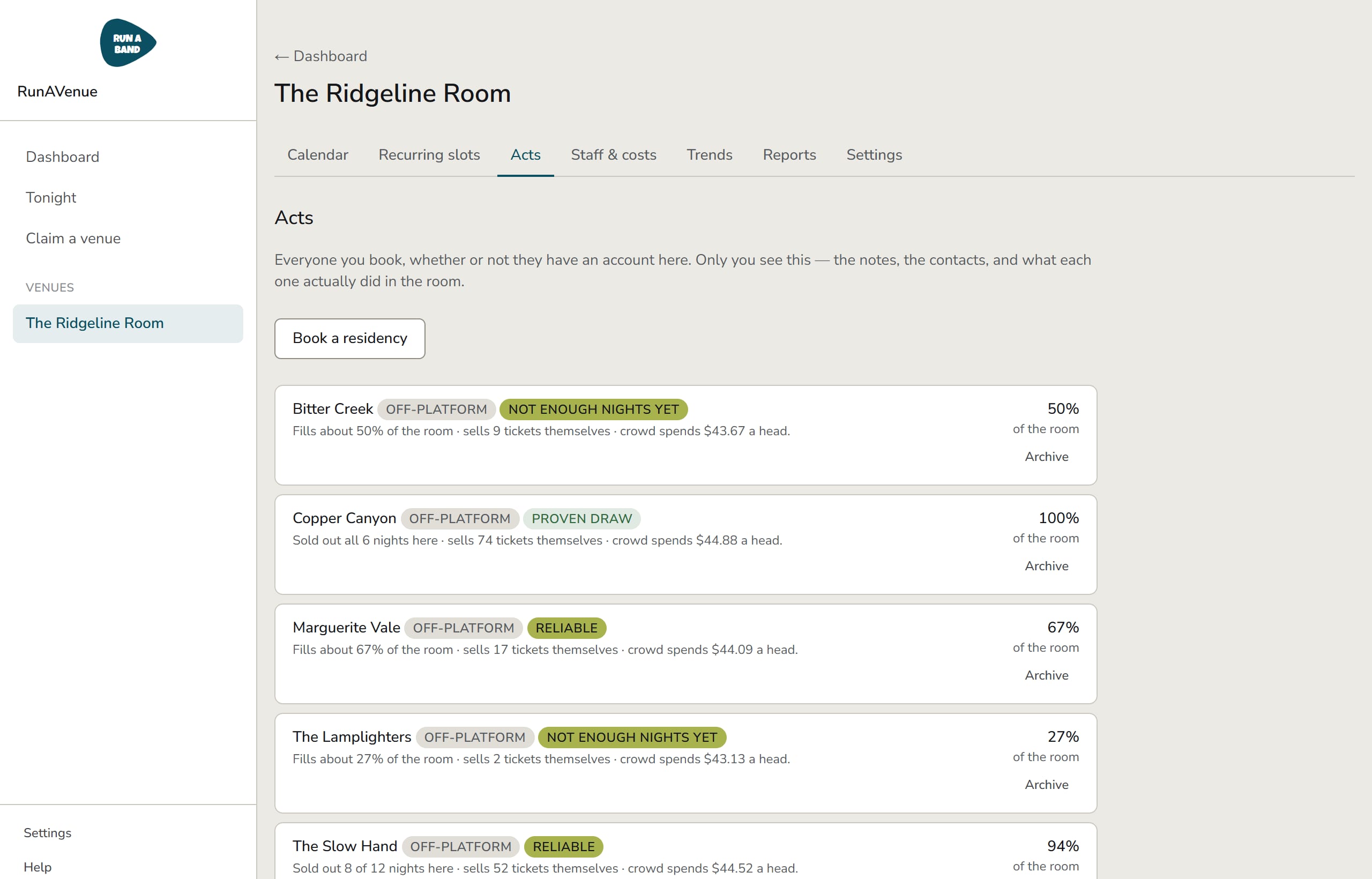
Every act you have booked, ranked on what they actually did in your room. Off-platform acts included — most of them are.
Filling the date
The bit that actually happens over three weeks
Booking is rarely one decision. It is a maybe, a pencil, a phone call, and eventually a yes — and a paper calendar can only record the last of those.
Hold it while they think
Pencil a date for an act and it stops being offered to anyone else. Every hold has an end date — it opens back up on its own, so a maybe from March can’t still be sitting on a Friday in June.
Offer it and let them answer
Send the date to a band you’re connected to. It asks; it doesn’t put anything on their calendar. They accept, and that books it — confirmed on both sides, no phone tag, no double-booking.
And when you don’t know who to ask
Free that night lists the acts you’re connected to who marked that date open, quietest calendar first — so you start with the one whose draw hasn’t already been spent on four other rooms that month.
Counts and distances only. You never see which other room — and nobody ever sees yours.
What the night has to take, before you say yes
Everything needed to work that out was already written down — the deals on the bill, the shifts rostered against the date, the night’s other costs, the ticket price — and it only ever came together the morning after. Which is the one moment it can’t change anything.
Now it’s on the date while you’re still deciding, and wherever there’s a ticket price it’s stated in heads — “78 paying in” is a picture of a Friday and $1,386.50 isn’t. A night that sells no admission still gets an answer, in money, because there is nothing to divide by and inventing a price would be the one figure here you’d act on directly.
- Acts
- $655.00
- Fixed cost
- $1,386.50
- Break-even door
- $1,386.50
- Paying in
- 78
- Once they drink
- 39
- The room draws
- 46
“Once they drink” credits each head with the bar and kitchen spend of a dark night this month. Event costs only.
No dark nights that month and it says there’s nothing to compare against, rather than implying the room draws nobody on its own. An hourly shift with no hours yet makes every figure a floor, and it says that too.
And what an empty-looking month actually means
“62% booked for October” tells you nothing on its own. It only means something next to what your Octobers actually come to — and next to the fact that your Fridays and your Tuesdays behave nothing alike, which averaging the two hides completely.
“5 of 13 nights open. This room’s Octobers finish at 86% booked.”
Per weekday, against your own history of that month. Note what it does not say: it won’t tell you you’re behind. Your history is of months that already finished, so it’s a finishing line rather than a checkpoint — and a month still eight weeks out is meant to have dates open. Calling that a deficit would put a permanent warning on a calendar behaving exactly as it always has. Only the month you are already in gets flagged.
A room that goes dark on Mondays isn’t permanently behind on Mondays either: a dark night is a decision, not unsold inventory, and it’s left out of the sum entirely.
- It won’t quote an expectation until it has three of that month behind it — three Octobers, not three months. Putting a booker under pressure against a number the software invented is worse than telling them there isn’t one.
- A weekday you have no history for says no history yet — never 0%.
- How far ahead you normally fill a Friday builds from bookings made here. It can’t be worked out from older ones, because nothing recorded when those were agreed — and the page says so instead of quietly leaving the reading out.
Between yes and paid
Booked isn’t the same as ready
A date in a calendar is a promise to be somewhere. Everything after it — the times, the door list, who’s actually on the bill — has always lived in a phone thread.
Advance it once, not eleven times
Load-in, soundcheck, doors, stage time. What the room provides, what they bring, where to park, who to find on the night. Fill it in as the answers arrive — nothing reaches the act until you send it, so nobody gets four half-written versions.
Then hand them a link to it
Most acts most rooms book don’t have an account anywhere. Give them a link and they get a page for that one date: the times, the details, a box to put their own people on the door, and somewhere to tell you what they need.
No money anywhere on it. A day sheet gets forwarded to a drummer and a driver, and forwarding it shouldn’t tell them what the act is being paid.
Two acts, one door
Add a support slot to any night and they share the room, the door and the advance. Then the part nobody had a number for: a bill adds up what you’ve actually promised.
Two acts on 60% each is more door than the door has. Give a flat fee to one and a share to the other, and that share still comes off the whole door, not off what’s left after the fee.
“The splits on this night add up to 120% of the door — more than there is. You’d owe 20% out of your own pocket.”
It warns; it never refuses. Giving away a door for one night is a real decision. It just shouldn’t happen without you seeing it.
How it’s selling, while you can still do something
Every ticket you’ve ever sold carries the moment it sold, so every past show already had a sales curve and your room already had a history of curves that ended somewhere known. All of it was read exactly once — on the night, to work out the door. Which is the one evening nothing can be done about it.
At fourteen days out you can still put money behind it, paper the house, or move an act down the bill. So the curve is on the date from the day it goes on sale, against your own comparable nights at the same point in theirs.
Your Friday sells over three weeks and your Tuesday sells in four days, so the two are never pooled. Advance sales only — a walk-up doesn’t exist until the doors open, and counting them would make every past show look like a late surge.
And it says nothing until it can say something true
Three comparable nights before it will call a pace at all; below that it tells you how many more it needs rather than guessing from one. A past show with no ticket lines is dropped, not read as a night that sold nothing — counting those drags the middle to the floor and tells you you’re ahead of a room that simply wasn’t recording.
And if every comparable night had all its tickets entered on the night itself, there is no advance curve to pace against. It says exactly that, rather than reporting a triumph.
14 days out: 61 sold against 94 on a comparable Fri/Sat night — 33 behind.
- Sold so far
- 61
- A comparable night, by now
- 94
- Those nights finished at
- 168
- Measured against
- 7 Fri/Sat nights
The middle of the room’s recent Fri/Sat nights, not the average, so one sell-out doesn’t redefine normal.
And on the night, it fits in one hand
Nobody works a door from a laptop. Tonight is what’s on across every room you run — times, who’s rostered, a button to call them when they’re late. Open one and you get the screen for running it.
Tick people in as they arrive; the whole row is the button. Sell walk-ups one or two at a time and they land on the door exactly as a desk entry would. Settle it at one in the morning without going anywhere.
Ticking is what makes someone a comp. Forty names where eleven turned up is eleven comps — counting the list instead overstates them on every act who puts people on the door.
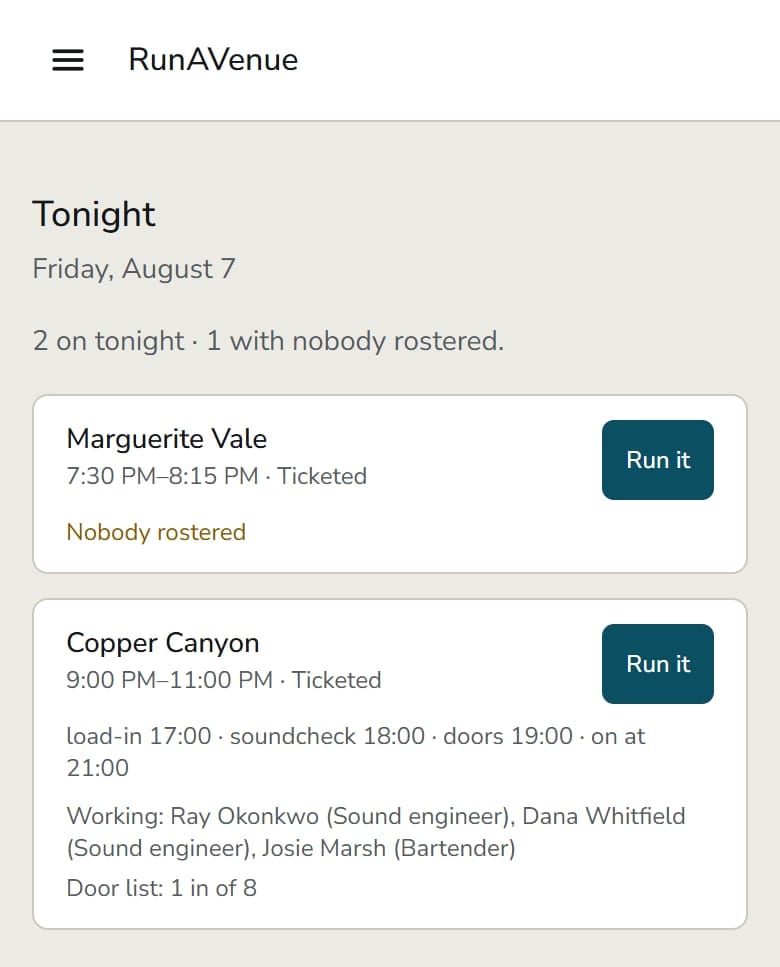
Both acts on tonight’s bill, and the one with nobody rostered saying so.
Guest names stay with the room. The act sees their own list and nobody else’s.
Trends
The shape of your year, checked against the books
Tell it how a normal year goes — you already know. The measured line builds underneath as nights settle, and where the two disagree is the interesting part.
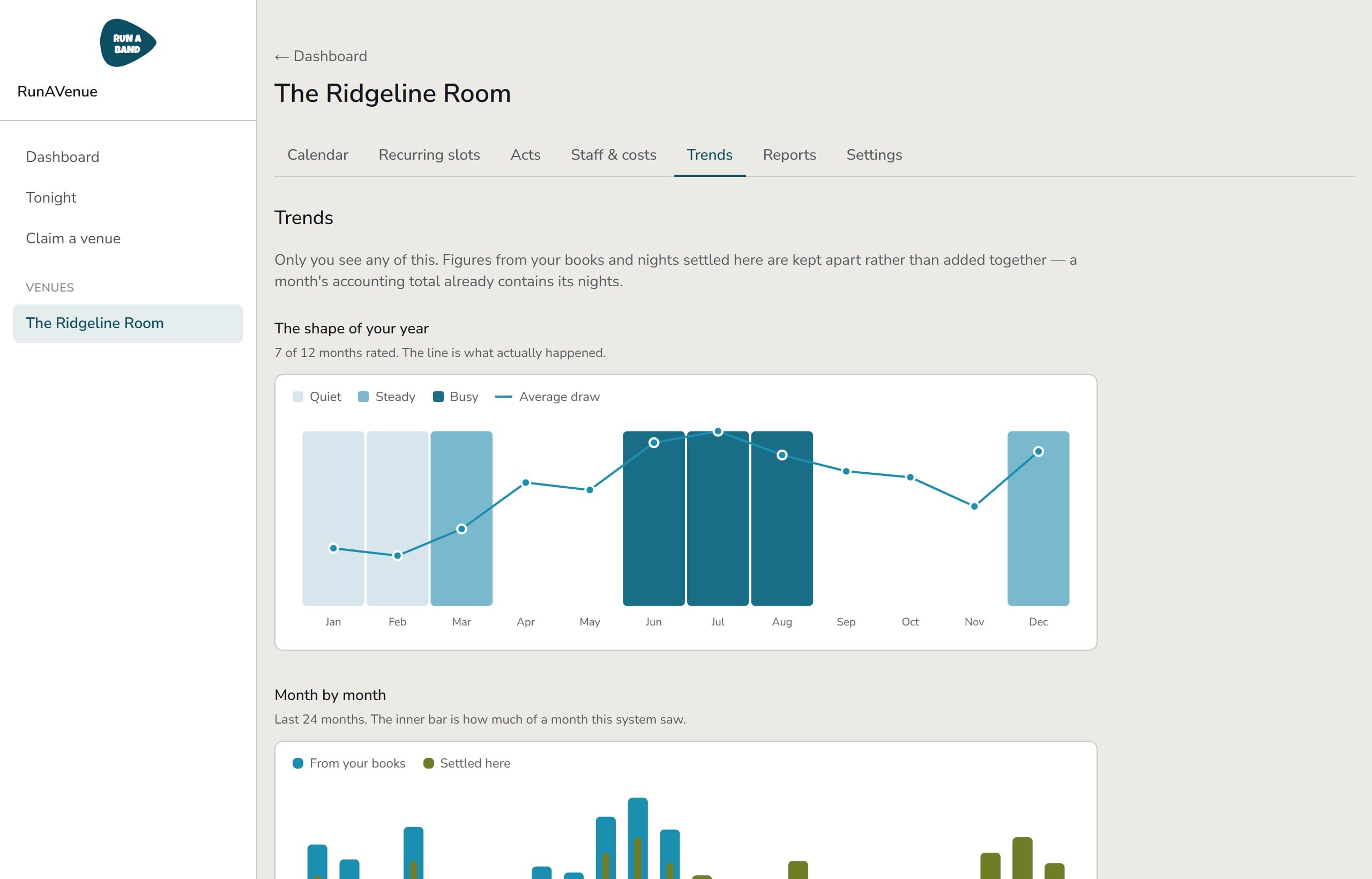
Your own rating of each month, with what the room measurably drew laid over it.
Start with two years of history, not two years of waiting
You already have the history. It is in a Google Calendar, a spreadsheet, or a wall planner. Upload the calendar you have been booking in — an .ics export or a CSV of dates and act names — and every one of those nights arrives as a booking, with the acts filed on your roster as they land. Nobody types in a year of Fridays.
Then type your monthly totals straight off an accounting report and the trend line exists today. Those figures are kept separate from nights settled here — a month’s accounting total already contains its nights, so adding them would double-count. The gap between the two is useful in itself: it tells you how much of a month the system actually saw.
An import carries the calendar and never the money. Your export knows who played; it has no idea what the door took, and a figure invented on the way in would sit in an act’s record next to ones somebody actually counted.
The inner bar is how much of a month settled here. Later months are settled nights only — the books haven’t been entered yet.
What each night cost, against what it returned
You already record what every act was paid. You already record what every night took over an ordinary one. Nothing had ever put the two side by side, and nobody does that arithmetic by hand across a year of Fridays.
“Cost $655 and put $2,140 over a normal night — $3.27 back for every dollar.”
“Cost $1,900 and took $420 under a normal night — $2,320 short.”
Both directions, ranked, and the nights that over-delivered come first. The Saturday you regret you already remember; the cheap act on a wet Tuesday who quietly paid for themselves is the one nothing has ever told you about.
Every row states both halves, because “$1,100 short” on its own reads as an overpaid act when half the time the fee was ordinary and the night simply didn’t draw — and you are the only person who can tell those apart. A night with no ordinary night to measure against, or a split that never settled, is held apart as unmeasurable. Never scored as returning nothing against somebody’s name.
And the dates that aren’t ordinary dates
A season rating is your judgement about a month. A baseline is what an ordinary night that month takes. Neither can see that the 26th of December isn’t an ordinary December night, or that the weekend the festival is on does something to your room every year. On a calendar those are just dates, and they get given away at the standard fee in March.
“26 Dec takes 64% over a normal night that month, across 3 years.”
It sits directly above your season ratings, and that pairing is the point — the same reason the ratings already sit next to measured draw. A December you call quiet that keeps drawing on the 26th is the finding.
- A date with one year behind it is labelled one year and sorts below every established pattern, however dramatic that year was. One good Boxing Night is a story, not a rule.
- The same date lands on a different weekday each year, and on a two-year sample that’s most of the variance. It says so on the row rather than correcting for it — with two observations there is nothing honest to correct with.
- A date that reliably empties the room is reported just as plainly. That’s the one worth knowing, if you’ve been staffing it as a normal night.
The one number you actually choose
Rent is fixed, stock is scheduled, staff are rostered. What an act costs is the figure you decide one booking at a time — which makes it the only one a budget can steer. Set what you mean to spend on acts in a month and bookings count against it as you make them.
The useful part is the split between spent and committed. Money promised to an act you’ve booked is gone as far as the next booking goes, but it hasn’t left the account — and reconciling against a bank statement needs both figures.
And it stays honest about what it doesn’t know
- A night paying a share of the door has no cost until it settles, so it counts as unknown rather than as zero. Guessing would make the budget most wrong on the nights that went best.
- The year only reckons against months you’ve actually budgeted. Spending in the others is shown separately, instead of reporting a healthy room as $30k over.
- Hospitality counts — the house tab is part of what an act cost you.
Owner-only, this one especially: an agent who knew what was left in the month would know the ceiling they’re negotiating against.
Also in the box
The rest of running a room
Know before you book
When an act asks for a date, you see how heavily they’re already playing the same market — pulled from their own gig calendar and their published tour dates.
“1 other show within 25 miles in the 30 days around this date — nearest is 4 days before, 2.7 miles away.”
No other venue’s calendar is ever exposed to make that work, and no venue is named.
Sound engineers, scheduled and paid
Your engineers get their own login: their shifts across every room they work, the stage plot and tech notes for the act they’re mixing, and their own pay — nothing else. When one can’t make it, another on your roster can pick it up without phoning you.
Bar, floor and door staff stay cost records with no login. Everyone’s shifts can sync to their phone calendar.
Booked in writing
Send the act a confirmation with their fee on it and they accept in one click, no account needed. It’s a snapshot from the moment you sent it, so changing the deal can’t quietly change what they were promised.
Nothing left owing
Nights that played but were never settled surface on their own, oldest first, with what each one is still missing. They’re the ones that cost you money quietly.
Residencies in one go
“Every third Thursday until June” books in one action. It only takes dates already on your calendar and still free — it won’t invent nights you’re shut — and it tells you how many it skipped rather than reporting a clean run.
Deposits, and your calendar anywhere
Track what a private hire put down and mark it received when it lands. And the whole calendar subscribes to your phone, as do each staff member’s own shifts.
The part that matters
Your numbers never leave your account
Venues don’t enter their takings into a tool that shows them to the people they negotiate with. So this one doesn’t — and that isn’t a setting you have to find, it’s how the software is built.
Bands see nothing
Not your door, not your bar, not your margin, not their own standing in your rankings. A band knowing you did 200 heads is a band whose guarantee goes up.
Agents see one number
What an act was paid, on the nights they work. Never what the room took. Revenue splits are yours alone to set, because a split payout can be divided back into the door. Break-even, pacing and what a night was worth aren’t hidden from them — those screens don’t exist on that side.
No pooled benchmarks
Your figures are never aggregated, sold, or compared with another venue’s. There is no industry dataset built out of your books.
Pricing
One subscription covers everyone you book.
Every act you book through RunAVenue gets a full Pro account at no cost — press kit, calendar, set lists, the lot. Better tools on their side means better information on yours.
Venue
Per room. Pricing set with you during setup.
- Booking calendar with ticketed, no-cover and private-hire nights
- Ticketing with tiers, walk-ups and per-act attribution
- Settlement, payouts and locked nights
- Staff costs, margin and break-even per night
- Act performance, season-adjusted, with a call list to work from
- Ticket pacing and booking pace, per weekday
- Trends, seasonality, notable dates and what each night was worth
- Import the calendar you book in today, plus accounting totals
- Sound engineer logins and shift cover
- Booking agents can work your calendar without seeing your books
Bands you book
Included with your subscription.
- Public press kit and stage plot
- Gigs, RSVPs, set lists and members
- Payments, mileage and year-end reports
- Calendar sync
- Their tour dates and tech notes reach you automatically
Start with one room and one month
Settle four nights and the picture starts forming. Upload the calendar you book in today, and type last year’s totals off an accounting report, and it forms immediately.